ABOUT BEYOND BAROQUE
Back to Our Space Page
Mike Kelley GALLERY
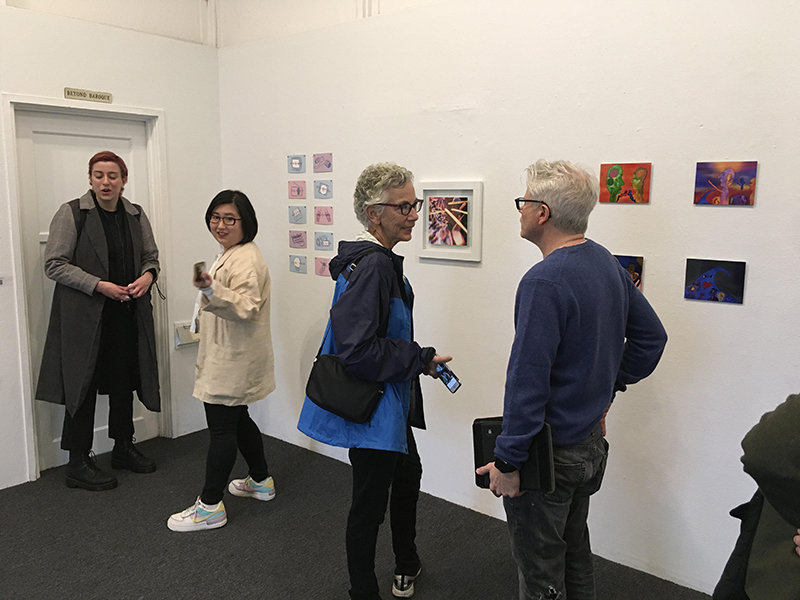
Mike Kelley was a world-renowned artist, but also a dear friend of Beyond Baroque. Many of his earliest performances and exhibitions were held in our space. Throughout his life, he remained among our most generous supporters. Our gallery was named in his honor, as a gesture of gratitude and memorial, after his death.
EXHIBITIONS
The poem My trembling candle
A selection of visual poems by J.I. (Judy) Kleinberg
April 11 - May 9, 2026
Opening Reception, Saturday April 11, 3-5 PM
Workshop, Saturday April 11, 11 AM - 1:30 PM

The poem My trembling candle is a selection of visual poems by J.I. (Judy) Kleinberg. The exhibit features framed original collages, about 4.25” x 5.5”, as well as enlargements in several sizes. The work in The poem My trembling candle touches on both the physical and the metaphorical. Doors seem to open on possibility as often as they open into rooms or houses. Light and shadow interplay in mood and spirit. Birds (tap-dancing with cardinals) cavort in an abbreviated syntax that Kleinberg describes as “somewhere between Dada and Twitter, between ransom note and haiku.”
A Los Angeles native and a long-time resident of Bellingham, Washington, J.I. (Judy) Kleinberg is an artist, poet, and freelance writer whose poetry has appeared in print and online journals and anthologies worldwide.
More information here.
Proxy Gallery Presents
xiouping:
modalities: the body keeps time
March 28 to May 9, 2026
Opening reception April 11, 3-5 pm

The work of artist xiouping is a 12-minute video and sound installation composed of a looped single-channel video. The camera stays in a fixed position inside a bedroom. We see a woman pushing someone in a wheelchair off camera, and then the same woman coming and going, tidying the room and the bed, carrying cups and bottles away from the bedside table, arranging medications, emptying the commode and changing the lining, placing new mattress protectors on the bed, and performing many actions indicative of caregiving to a disabled person, who is off camera. Also off-camera there are sounds of language fragments in English and Taiwanese, and English subtitles. The work is organized by the tension between the seen and the unseen, produced through strict formal constraints: cleaning, feeding, and tending. The patient is unseen, while the caregiver’s body and labor are centered. Care persists without exit, and rest is structurally withheld.
The actions happen for someone, by someone else. The actions are repeated, interrupted, paused, taking a certain amount of time in real time, constituting the conditions and the duration of care, hence the artwork. Emotions are neither shown nor implied. The receiver of care is not visible, perhaps for privacy and dignity, or perhaps because the video is primarily a portrait of the caregiver. In medical terminology, modalities are specific methods, tools, or techniques used to achieve a particular result, commonly applied in healthcare to treat conditions, or in physical therapy to relieve pain. But here modalities are also the formal devices that structure the video but also the conditions of its reception by the viewer who sees what is in front of their eyes, by they are also given the time to free-associate, imagine, empathize, assume or presume: is the caregiver the same person as the artist? Are we not witnessing the invisible labor of women and immigrants? Is the caregiver a professional or a family member?
In many ways, this one long take video is informed by the tradition of films of “ordinary experience” as Frederick Wiseman called them, the intentionally boring observations of everyday rituals and situations, or the immersive, static shots of Chantal Ackerman. What xiouping’s video shares with Wiseman and Ackerman is also its unrelenting materialism, refusing metaphor or explanatory voice-overs and focusing as it does on everyday actions in real time. The body indeed keeps time, both for the receiver and for the giver of care.
The “walls” of the proxy Gallery mirror the walls of a room and underscore the idea of a boundary. Special conditions of viewing arranged by the artist take accessibility into account: The gallery is placed at a lower height to be visible from a seat or a wheelchair. In this way the installation does not assume a default upright, able-bodied viewing position. Instead, it allows for multiple physical orientations to the work — standing briefly, leaning, or sitting. Care reorganizes how bodies relate to space, and the viewing condition reflects that variability rather than prescribing a single normative stance.
For more information visit Proxy Gallery online here.
For past Proxy Gallery shows at Beyond Baroque click here.
Gallery Hours:
Tuesday-Thursday 2-6:00 p.m. by appointment
Friday and Saturday 12-6:00 p.m. open
Exhibition Archive
Víctor Mortales: Language is a Place
January 17 - March 21, 2026
East of Western: Close Ups of Charles Bukowski by Joan Ganny
October 11 - December 20, 2025
Seven
Lorraine Bubar, June Edmonds, Linda King, Robin Mitchell, Pam Posey, Fran Siegel & Jody Zellen
April 12 - July 26, 2025
Ansel Krut
26 Random Words Arranged Alphabetically with 26 Unrelated Images
February 1 - April 5, 2025
Byron Baker & Will Alexander
Anonymous Steller Ravines vol 1.
October 12 - December 14, 2024
Cut Out
June 22 - September 29, 2024
Vincent Johnson: 17 Place Vendôme
May 4 - June 15, 2024
Gilah Yelin Hirsch
Radiance: Murmurations and Emanations
March 17 – April 28, 2024
Bob Branaman: Horizons
November 11, 2023 - March 2, 2024
Where Has All the (affordable) Housing Gone?
September 17 - November 4, 2023
One Sings The Other Dances
An exhibition by Renee Petropoulos and Benjamin Weissman
March 18 – August 5, 2023
Los Angeles: Now & Then
January 14 - March 4, 2023
Tony Cokes: So to speak
February 10 - February 19, 2023
1¢ LIFE
October 8 - December 17, 2022
Telepathic Evanescences: collaborative artworks by Will Alexander and Byron Baker
June 17 - August 6, 2022
7x7.LA: Selected Artist & Writer Collaborations
March 19 - May 28, 2022
Found / Made
Deborah Aschheim, Jan Blair, York Chang, Sam Durant, Tm Gratkowski, Kathleen Henderson
Stas Orlovski, Camilla Taylor, HK Zamani and Jody Zellen
October - November, 2021
Paulina Peavy: Etherian Channeler
Curated by Laura Whitcomb of Label Curatorial
June 1 - August 14, 2021
Only a Few Yards Away:
A Virtual Exhibit of Photography,
Paintings & Collage
Holaday Mason & Celeste Goyer
wall texts by James Cushing
April 5 - May 28, 2021
Floating Worlds
Spring 2020
Layered Beyond: An Augmented Reality Exhibition
February 9 - March 15, 2020
A selection of visual poems by J.I. (Judy) Kleinberg
April 11 - May 9, 2026
Opening Reception, Saturday April 11, 3-5 PM
Workshop, Saturday April 11, 11 AM - 1:30 PM

The poem My trembling candle is a selection of visual poems by J.I. (Judy) Kleinberg. The exhibit features framed original collages, about 4.25” x 5.5”, as well as enlargements in several sizes. The work in The poem My trembling candle touches on both the physical and the metaphorical. Doors seem to open on possibility as often as they open into rooms or houses. Light and shadow interplay in mood and spirit. Birds (tap-dancing with cardinals) cavort in an abbreviated syntax that Kleinberg describes as “somewhere between Dada and Twitter, between ransom note and haiku.”
A Los Angeles native and a long-time resident of Bellingham, Washington, J.I. (Judy) Kleinberg is an artist, poet, and freelance writer whose poetry has appeared in print and online journals and anthologies worldwide.
More information here.
Proxy Gallery Presents
xiouping:
modalities: the body keeps time
March 28 to May 9, 2026
Opening reception April 11, 3-5 pm

The work of artist xiouping is a 12-minute video and sound installation composed of a looped single-channel video. The camera stays in a fixed position inside a bedroom. We see a woman pushing someone in a wheelchair off camera, and then the same woman coming and going, tidying the room and the bed, carrying cups and bottles away from the bedside table, arranging medications, emptying the commode and changing the lining, placing new mattress protectors on the bed, and performing many actions indicative of caregiving to a disabled person, who is off camera. Also off-camera there are sounds of language fragments in English and Taiwanese, and English subtitles. The work is organized by the tension between the seen and the unseen, produced through strict formal constraints: cleaning, feeding, and tending. The patient is unseen, while the caregiver’s body and labor are centered. Care persists without exit, and rest is structurally withheld.
The actions happen for someone, by someone else. The actions are repeated, interrupted, paused, taking a certain amount of time in real time, constituting the conditions and the duration of care, hence the artwork. Emotions are neither shown nor implied. The receiver of care is not visible, perhaps for privacy and dignity, or perhaps because the video is primarily a portrait of the caregiver. In medical terminology, modalities are specific methods, tools, or techniques used to achieve a particular result, commonly applied in healthcare to treat conditions, or in physical therapy to relieve pain. But here modalities are also the formal devices that structure the video but also the conditions of its reception by the viewer who sees what is in front of their eyes, by they are also given the time to free-associate, imagine, empathize, assume or presume: is the caregiver the same person as the artist? Are we not witnessing the invisible labor of women and immigrants? Is the caregiver a professional or a family member?
In many ways, this one long take video is informed by the tradition of films of “ordinary experience” as Frederick Wiseman called them, the intentionally boring observations of everyday rituals and situations, or the immersive, static shots of Chantal Ackerman. What xiouping’s video shares with Wiseman and Ackerman is also its unrelenting materialism, refusing metaphor or explanatory voice-overs and focusing as it does on everyday actions in real time. The body indeed keeps time, both for the receiver and for the giver of care.
The “walls” of the proxy Gallery mirror the walls of a room and underscore the idea of a boundary. Special conditions of viewing arranged by the artist take accessibility into account: The gallery is placed at a lower height to be visible from a seat or a wheelchair. In this way the installation does not assume a default upright, able-bodied viewing position. Instead, it allows for multiple physical orientations to the work — standing briefly, leaning, or sitting. Care reorganizes how bodies relate to space, and the viewing condition reflects that variability rather than prescribing a single normative stance.
For more information visit Proxy Gallery online here.
For past Proxy Gallery shows at Beyond Baroque click here.
Gallery Hours:
Tuesday-Thursday 2-6:00 p.m. by appointment
Friday and Saturday 12-6:00 p.m. open